The focus of this article is paper money, or currency.
Not coins. The laws for currency are more restrictive than for coins. If you can do something to paper money you can likely do it, and more, with coins.
The starting point is Title 18 Section 333 of the United States Code. The law states:"Whoever mutilates, cuts, defaces, disfigures, or perforates, or unites or cements together, or does any other thing to any bank bill, draft, note, or other evidence of debt issued by any national banking association, or Federal Reserve bank, or the Federal Reserve System, with intent to render such bank bill, draft, note, or other evidence of debt unfit to be reissued, shall be fined under this title or imprisoned not more than six months, or both."
The Law is Not Limited to "Defacing"
The first point to note is the law is not limited to defacing or cutting up or burning money.
The words "or does any other thing" are unlimited in meaning.
They could refer to spitting on money. Using it as toilet paper. Anything you can imagine. If you can do it to money then section 333 may apply.
Defacing Money, by Itself is Not Illegal
The second point to note is the law does not make defacing money illegal.
What is illegal is to do something to money, "with the intent" to make it unfit to be reissued.
Reissued, as I understand it, although trying to find an official definition is surprisingly difficult, is if the US government receives the money to put the bills back into circulation and use.
The means what is illegal requires three things:
1. Doing something to money, such as defacing it,
2. That renders it unfit to be reissued, and
3. Taking the action with the intent to make it unfit to be reissued.
For example, what if the President autographs a dollar bill?
He (or she) has doing something to currency. One might argue it has been defaced.
But is it unfit for reissue?
And if unfit, was there an intent to make it unfit?
The answers to those latter two questions are undoubtedly no.
This example came up in a fact check question on Politifact when Hillary Clinton did not believe she could autograph money, but her husband Bill Clinton already had!
The Politifact article was written in 2007, and at the time noted the Treasury Department had a fact sheet stating:"Throughout the years, the Secretary of the Treasury and the Treasurer of the United States have autographed currency notes bearing their signatures at the request of private citizens. This practice is not considered as defacement since the autographs are generally provided to persons as keepsakes as opposed to circulating currency."
First Amendment Rights
Is there a First Amendment constitutional right to make a statement on money?
A constitutional right will trump a law such as section 333.
I did not find any definitive legal answer.
The United States Supreme Court in Smith v Goguen noted one cannot burn down a building to make a political statement. That is arson and there is a competing constitutional right of the government to protect life, liberty and property.
But doing something to money, isn't that your own property?
Don't you have a right to do whatever you want with your own property?
The Supreme Court in that Goguen case noted there are many limits on what you can do with your property.
For example, there are zoning laws.
One cannot sell their gun to whoever they want.
But doing something to money does not seem to involve the interests of others, such as zoning laws affecting a community or another person wanting to buy a gun.
The Supreme Court noted there are laws where the government claims a property interest in private property.
One these laws is section 333 and what a person can do with their privately owned money.
The Supreme Court also noted "many of these statutes, though long on the books, have never been Judicially construed or even challenged."
In United States v Eichman the Supreme Court held a law making it illegal to deface the flag was unconstitutional because it infringed on First Amendment rights.
The court noted it was dealing with an issue of political speech and not a commercial exploitation of the flag.
Artists Do Not Violate the Law
With art being added to money, there are generally two general intents.
First, as with a Presidential autograph, there is an intent to create a keepsake that a person buys and keeps. They may frame it on the wall.
Does a collector violate section 333 because they keep money instead of letting it be reissued? Obviously not, although arguably it is a violation of the law.
But to avoid making the law absurd in light of general practices, framing a dollar bill and putting it on the wall is not a problem.
Second, an opposite intent of making a keepsake is to have money circulate with an artistic point on the money being seen by as many people as possible.
For instance, an offensive statement about the President written on money is designed not to take the money out of circulation. The intent is for the statement to be seen by as many people as possible.
Obviously, or I hope it is obvious, what is "offensive" to one person may be loved by another. It is in the eye of the beholder. The government cannot restrict an "offensive" statement on money but allow an autograph because that content based determination goes to the heart of what the First Amendment protects.
In either circumstance there is no violation of the law. There is no intent to make the money unfit to be reissued.
The fact is many artists publicly deface, cut, destroy, and re-arrange currency. This is publicly done and shown in art galleries. They are not prosecuted.
For example, artist Mark Wagner is known for cutting apart dollar bills, taking the pieces and re-arranging them into collages and new pictures. Like this:
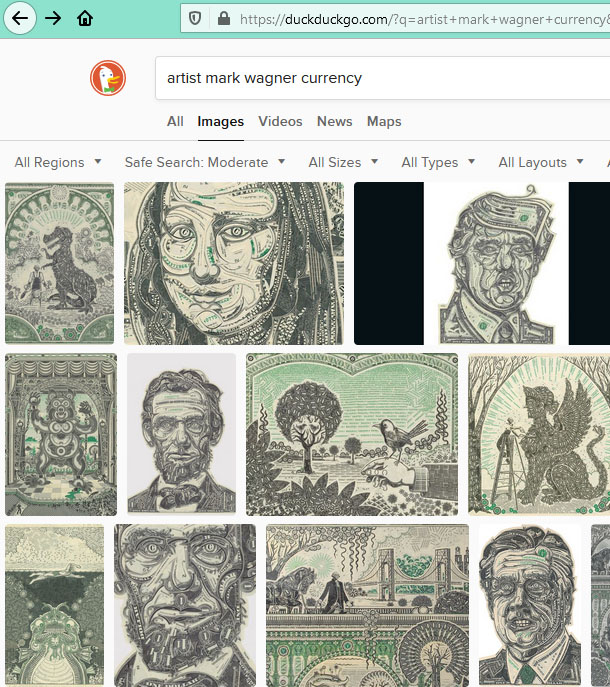
Without question, what he is does is deface, cut, mutilate, etc. currency, and he intentionally does so knowing it is impossible to re-issue it.
An obvious and plain violation of section 333?
Wagner has his own public Wikipedia page which notes the many places he has exhibited his art, including the National Portrait Gallery at the Smithsonian Institution in Washington, DC.
He notes on his website that his art has been collected by the United States Federal Reserve Board!
In other words, the government is aware of intentional defacement and mutilation of currency to make it unfit to be re-issued and, instead of prosecuting, promotes it as art to the public.
Bottom line: Don't worry about using currency as part of your art.